October 13, 2024
What I’m Seeing, What I’m Reading
September 24, 2024
Norway in November Sign Up Post
Word is getting around that I am hosting Norway in November this autumn. It comes from a great passion I have for Jon Fosse, but other Norwegian authors as well. I have recently finished Emily Forever by Maria Navarro Skaranger, and Kristin Lavransdattar Book I: The Wreath by Sigrid Undset, both outstanding books about young women, although the later is set in the 14th century, and the former is in the present time. They each had something to teach me…
In November I am planning on focusing on Jon Fosse, however, rereading Septology (for the third time) as it is so profound. If you choose to join us, which I hope you do, you need not focus on him. Please choose any work originally written by a Norwegian author and tell us your thoughts. I look forward to reading about what you have chosen!
Leave your name and the post about your choice(s) here if you would like to participate:
September 8, 2024
Sunday Salon: Let’s Talk about Norway in November, Specifically Some Book Suggestions
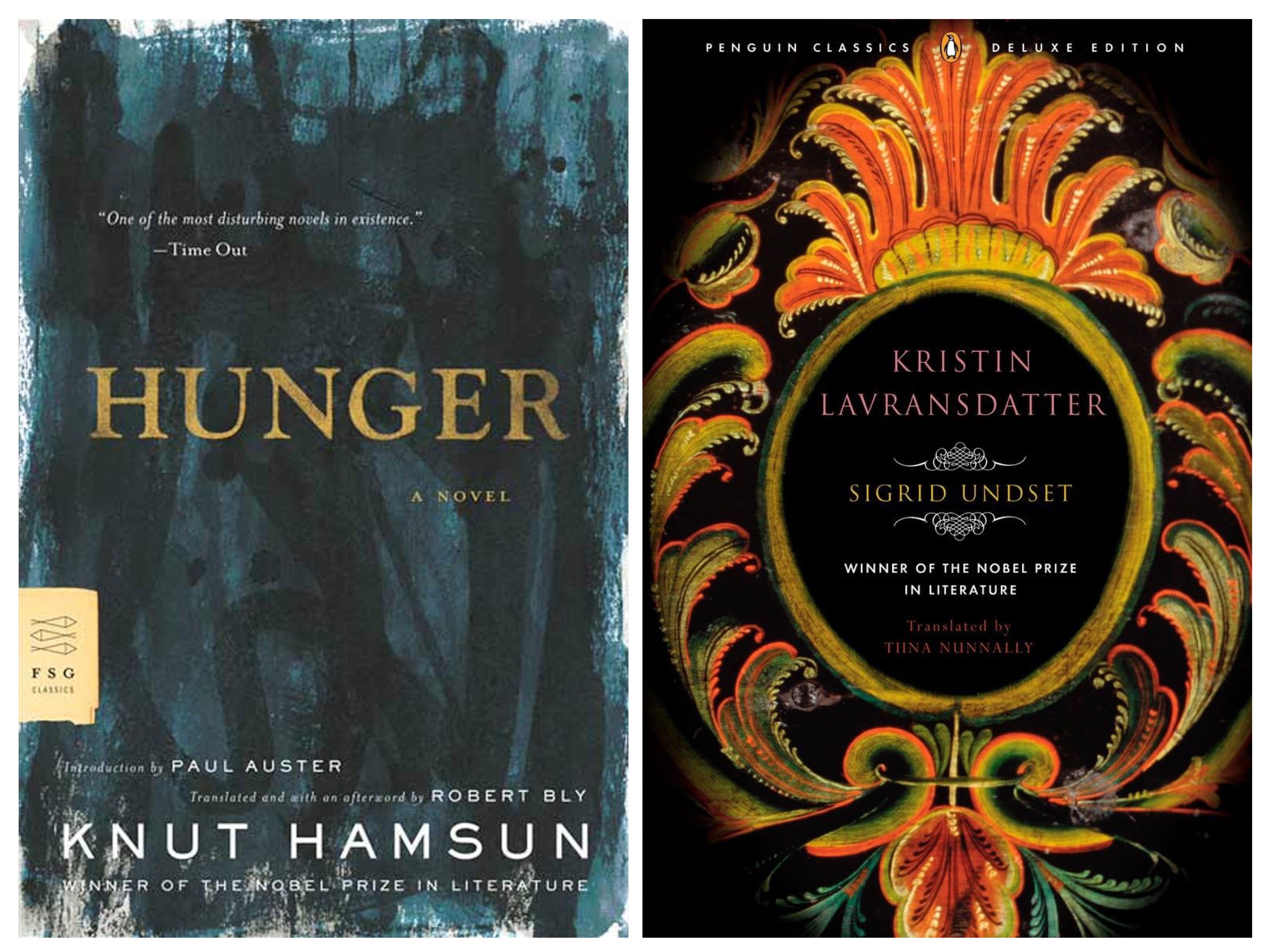
I have been searching for some highly recommended books which I leave for you here, in pairs instead of single images as that will make the post a bit shorter. I hope you find something which appeals to you should you choose to join us this Norway In November. (Some of them apply for Nonfiction November or Novellas in November as well.)
Hunger by Knut Hamsun
Kristin Lavransdattar by Sigrid Undset
A Doll’s House by Henrik Ibsen
The House with the Blind Glass Windows by Herbjorg Wassmo
The Birds by Tarjei Vesaas
Giants in the Earth by Ole Edvart Rolvaag
The Other Name by Jon Fosse (I-II)
I Is Another by Jon Fosse (III-V)
A New Name by Jon Fosse (VI-VII)
(These three books comprise the volume entitled Septology. after which Jon Fosse won the Nobel Prize in Literature in 2023. I read them singly, as they were not all published when I began reading, and I recommend taking them slowly, one by one.)
Aliss At the Fire by Jon Fosse
(perfect for Novellas In November)
A Shining by Jon Fosse
Scenes from a Childhood by Jon Fosse
Well, you can see that I have listed more books by Jon Fosse than any other, but that is because he has become one of my favorite authors. I have read The Other Name, I is Another, A New Name, Aliss At the Fire, and Scenes From a Childhood (which are short vignettes of the most piercing nature). I still look forward to reading Melancholy I-II and Trilogy, as well as A Shining. Obviously, there are so many more Norwegian authors to discover; I have only attempted to whet your appetite here, in the hopes that you will join us this November. A review site is soon to come…
I have linked this post with Sunday Salon, as this is what is uppermost in my mind today.
September 2, 2024
Norway in November…A New Literature Challenge Because I Am A Fosse Fanatic
Perhaps you have heard of Norwegian crime writers, such as Karin Fossum or Gunnar Staalesen. Maybe Jo Nesbo? If you are in the mood for something more action filled, you may wish to pick up a psychological thriller. Believe me, they are nothing like an American thriller, which seems to follow the same plot line over and over again. (The Girl…fill in the blank.)
Or, you may prefer a classic work with more historical value, such as something written by Henrik Ibsen or Knut Hamsun.
If you’re planning to read for Nonfiction November, there are several options, as well options for Novellas in November; I think it’s fun to combine reading events.
I am going to leave a compilation of Fosse works published by Fitzcarraldo Editions, with a much more complete list of Norwegian authors to come, hoping that something will catch your eye and you’ll join me in Norway this November. I’d surely hate to go alone.
A selection of books by Jon Fosse, awarded the 2023 Nobel Prize in Literature ‘for his innovative plays and prose which give voice to the unsayable’, in Damion Searls’s translations.
Included publications:
August 31, 2024
Sunday Salon: August, the month that was
The 20 Books of Summer turned into 15 for me. But, they were a good fifteen; I had a wonderful Summer of reading. My favorite books from the list include Lonesome Dove by Larry McMurtry, Madame Bovary by Gustave Flaubert, and Scenes From A Childhood by Jon Fosse. The first I read for Classic Club Spin #38. The second I read for Paris in July. The third I read because Jon Fosse has become my favorite author, replacing Haruki Murakami who formerly held that position ever since I hosted the first Japanese Literature Challenge in 2006. (Does this mean I should host a Norwegian Literature Challenge sometime? 🤔)
And now for something completely different: are you waking up with golf ball sized welts that seem to have come from nowhere? My son was so terrified his new apartment had come with bedbugs that he called Orkin, and for $300.00 had the whole thing sprayed. I’m afraid they took advantage of him for it doesn’t appear that bedbugs are the culprit. No, in Illinois the culprits are Oak Mites, which feast on eggs the cicadas have left behind. You can’t see them. You can’t feel them sting you. But the itch that they leave behind is nearly intolerable. None of the creams we have bought are terribly effective; the best thing I’ve found is holding an ice cube up to my skin until it melts.
Also, staying inside and reading on the couch helps. I have begun reading for the R.I.P. XIX, which runs from September 1 through October 31. No longer does Carl from Stainless Steel Droppings run the event (where have so many of my blogging friends gone?!). Instead, you can post, and read about Readers Imbibing Peril, on Instagram at #ripxix.
It is sad to say goodbye to Summer. There has been such joy in swimming at Centennial Beach, and participating in all the reading adventures so many have provided. Thank you Cathy, and Emma, for hosting your reading challenges. Thank you Deb Nance for hosting Sunday Salon all this time!
Happy September to all.
August 26, 2024
The Other Woman by Therese Bohman, translated from the Swedish by Marlaine Delargy, for Women in Translation Month
My heart grieves for the women who think that married men will choose them over their wives. Because a married man has sought a woman out, has felt that she would satiate a yearning for him, does not mean that he will sacrifice his perfectly comfortable, albeit boring, life for her.
Alternatively, two of my all time favorite books, Madame Bovary and Anna Karenina, portray women who desperately abandon everything for the men that they love, and still they are not happy. Romance, illicit or otherwise, cannot fulfill the deepest hunger for love and passion.
The Other Woman had such an intriguing cover to me that I borrowed it from Boundless (the most annoying library app ever). Finding that it had been translated from Swedish made it a perfect read for Women in Translation Month which is quickly drawing to a close; furthermore, Other Press has just sent me Bohman’s latest book, Andromeda, to review. I wanted to know more about Therese Bohman’s previous work before embarking on her latest.
My whole body burns with a feeling I can’t quite define: anger, jealousy, the sense of being left out. The knowledge that I never come first. (p. 149)
Thus speaks the narrator of The Other Woman, when the initial thrill has begun to wane. She is an attractive girl in her late twenties, wanting to become a writer, but working at the Norkopping hospital kitchen in the meantime. When Carl Malmberg, a handsome doctor, offers her a ride home, she agrees. She has noticed his wedding ring, but it pales next to the shiny, dark blue Volvo that he drives. And, it seems to fall from her vision altogether when he eventually holds her in his arms, whispering lovely things in her bed.
Her life seems shabby next to his. His wife, Gabriella, and he have the finest things in a beautifully decorated apartment on the top floor of their building. Their life is ordered and complete, with children from their own marriage, and older children from the marriage Carl had before. We know nothing good can come from his liaison with this “other woman.”
The resolution is surprising, and far different than I had anticipated. Seeing how this particular relationship sorts out, combined with descriptions of intense emotion, were the thrill of the novel. As Other Press says, this book is “a passionate psychological drama where questions of power and sexuality are brought to a head.”
August 24, 2024
The Empusium: A Health Resort Horror Story by Olga Tokarczuk for Women In Translation Month
The Empusium is one of the most wonderfully atmospheric books I have read in a long time. The forest trees, moss, and lichen create their own ominous mood:
The ritual of the fall had started, as if the proximity of death activated reserves of extraordinary energy in these trees that, instead of continuing to support life, allowed them to celebrate dying…As we know, however, the most interesting things are always in the shadows, in the invisible.
Upon closing the cover after finishing the last page, I am not entirely sure that I understand it. But, Olga Tokarczuk has given me much to ponder.
Mieczylaw Wojnicz has come from Poland to a sanatorium in Gorbersdorf, to live in a kurhaus for those suffering consumption. While he waits for a room there, he is taken to the Guesthouse for Gentleman, run by Herr Opitz. And soon after his arrival, he sees the body of a woman lying in the dining room table; it is Frau Opitz who has died.
Mieczylaw hears noises in the night, and when alone, he investigates the rooms above him. One is Frau Opitz’, where he tries on her clothes (her slippers fit him perfectly), and lies in her bed feeling great peace. The other room is an attic, containing a chair to which are attached great leather straps…the sense of foreboding is ominous.
The men at the Guesthouse for Gentleman have discussions around the dinner table, much of which consist of disparaging women. They also partake of a liquor called Schwärmerei, made from mushrooms in the forest, which tastes earthy but clearly makes their heads heavy and calms them down.
We are told that Wojnicz has been uncomfortable all his life undressing in front of the doctors, who always insist he must remove even his drawers. At first I think this is because he is shy. Later, I come to understand it is because of what his underwear hides.
He makes friends with Thilo, who bequeaths him this photo:
They both have admired it greatly, noticing that when you look at it in certain ways you can see different things. This, I think, has something to do with the point Olga Tokarczuk is making: we see what it is that we want to see, and sometimes, our perspective shifts with the blink of an eye.
One more interesting concept…an Empusa is a shape-shifting female being in Greek mythology, a demonic ghost sent by the goddess Hecate and appearing to the ill-fated. How is it then, that The Empusium contains no women at all, unless we look more closely at Mieczylaw?
I have read this book for Women In Translation month, always an enriching experience in the book blogging world. Also, thanks to Fitzcarraldo Editions who sent me an advanced copy of this book, to be published September 26, 2024.